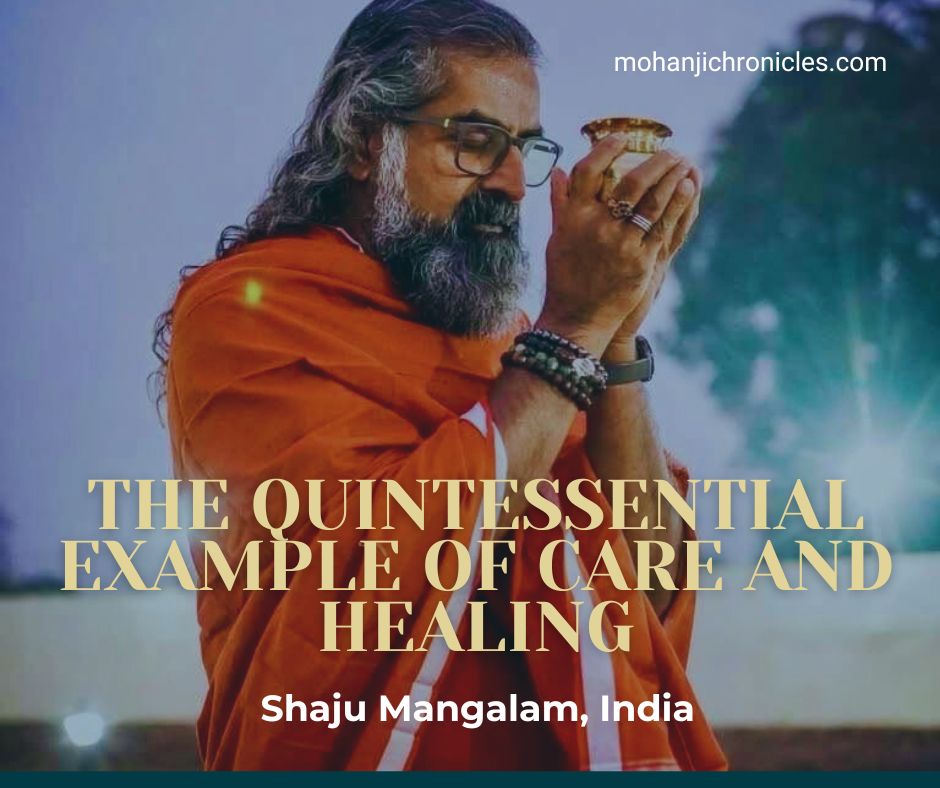
by Shaju Mangalam, India
Care and healing, in their truest sense, are not acts of convenience or selective kindness. They are expressions of consciousness that rise beyond judgment, memory, and personal history. They demand courage, maturity, and a heart that has transcended the instinct to measure worth through past actions. In my journey of observing life, very few individuals embody this principle in both word and action. Mohanji stands as a quintessential example of this rare and elevated state of being.
“When an individual is in a dire and fallen state and seeks your help, never turn a blind eye. Do your best to help that person come out of the situation. At that moment, their karmic past should never stand as a wall against compassion.”
– Mohanji
This is not a philosophical statement meant for admiration or debate—it is a lived truth. He has consistently demonstrated this principle, even when doing so required personal sacrifice, emotional resilience, and complete transcendence of ego.
A fallen state, according to Mohanji, is the most vulnerable phase of a human life. It is when a person’s defenses collapse, when pride dissolves, and when survival itself becomes uncertain. At such moments, judgment is cruelty, and indifference is violence. What is required instead is presence, support, and action—whatever one can offer, without questioning whether the person “deserves” it.
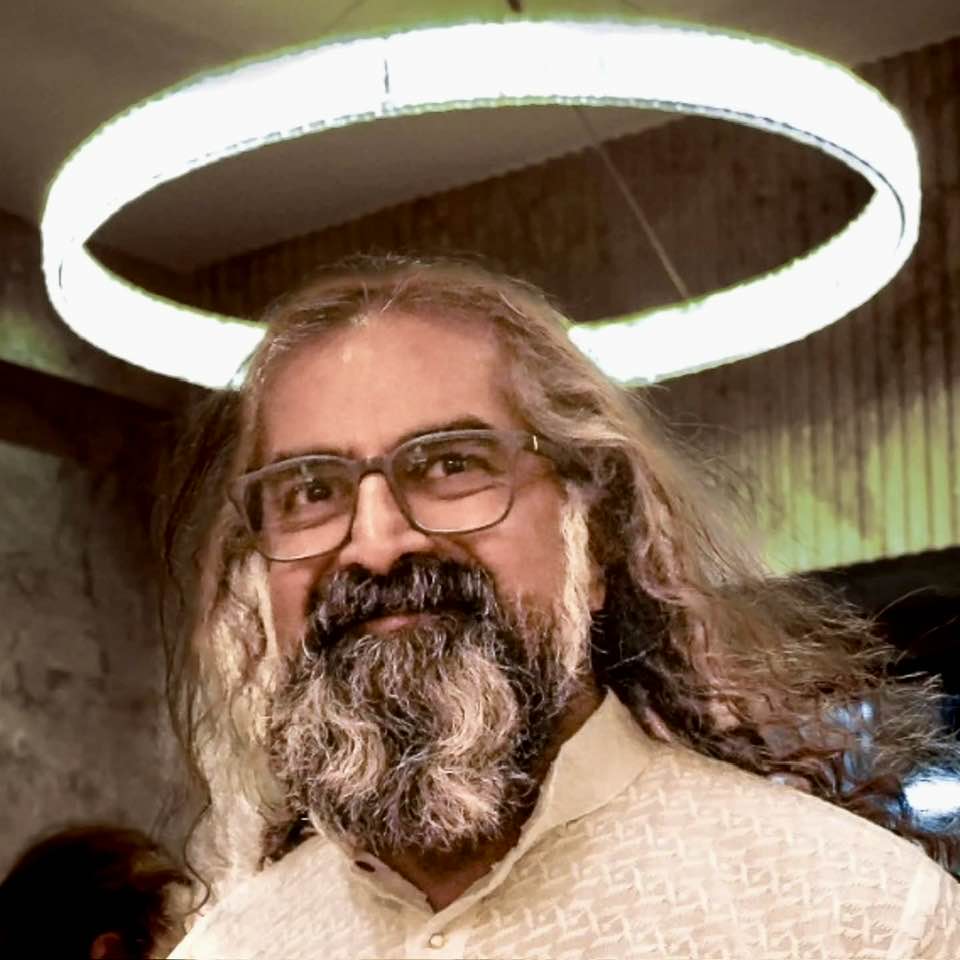
Mohanji never turns away a seeker, irrespective of their past conduct, character, or moral failures. To him, a seeker is not defined by history but by the sincerity of their need at that moment. He does not measure people by their past deeds or calculate whether they are worthy of help. The fallen state itself becomes the sole qualification for compassion.
This approach was initially difficult for me to comprehend. Like many, I once viewed the world through lenses of judgment, conditioning, and social logic. I believed that actions had consequences—and that people must bear them. I subconsciously evaluated whether someone was deserving of help based on their past behavior, relationships, or attitudes. In this conditioned mindset, generosity had limits, and compassion came with boundaries.
Watching Mohanji challenged this worldview profoundly.
There have been innumerable occasions when I struggled internally while witnessing the depth and breadth of his generosity. People whom society would label as irresponsible, manipulative, or morally questionable were met by Mohanji with the same calm presence and willingness to help as anyone else. There was no visible resentment, no moral lecturing, no silent condemnation. Only action—quiet, decisive, and complete.
What unsettled me the most was not his compassion toward strangers, but toward those who were close to him—especially family members who, in the past, had ignored him, dismissed him, or kept him at a distance. These were people who had consciously chosen separation, shown indifference during his difficult phases, and failed to acknowledge his presence or path.
Yet, when life placed them in desperate circumstances—when survival, dignity, or continuity of life itself was at stake—Mohanji did not hesitate.
He did not revisit the past.
He did not remind them of their neglect.
He did not demand reconciliation or recognition.

Instead, he responded as a Rajayogi—rooted in equanimity, detached from personal hurt, and fully aligned with dharma. He extended full support, often going far beyond what was expected or even reasonable. Financial help, emotional anchoring, guidance, and stability—everything required to steady not just the individual but their entire family—were offered without reservation.
To witness this was both humbling and unsettling.
Humbling, because it revealed the limitations of my own compassion.
Unsettling, because it dismantled the very framework through which I had understood justice and fairness.
Mohanji does not operate from the transactional logic of the world. His actions are not guided by reward, gratitude, or acknowledgment. He does not expect apologies, loyalty, or even understanding in return. His compass is singular and unwavering: “My duty is to help that soul.”
This statement carries immense depth. Duty, in this sense, is not an obligation imposed by relationships or society—it is a spontaneous response of awareness. When one recognizes the suffering of another being, the response arises naturally, without internal debate. There is no “why” or “whether.” There is only “what can be done now.”
Another profound aspect of Mohanji’s approach is that his compassion is never entangling. While he helps fully, he does not bind people to himself emotionally or energetically. There is no creation of dependency, guilt, or obligation. Help is given freely, and freedom is preserved. This balance—between deep compassion and complete detachment—is extraordinarily rare.
In contrast, much of what the world calls “help” is mixed with expectations. We help with the hope of being remembered, respected, or repaid. Even charity often carries subtle ego gratification. Mohanji’s compassion is different. It is silent, unadvertised, and often unseen. Many beneficiaries may never even realize the depth of what was done for them.
Over time, observing this way of living reshaped my understanding of care and healing. Healing is not merely curing a problem or resolving a crisis. True healing restores dignity, stability, and inner strength. It helps a person stand again without making them feel small. Mohanji’s help does exactly that—it lifts without humiliating, supports without controlling, and gives without binding.
Through these experiences, I began to see my own conditioning clearly. Judgment often masquerades as wisdom. Prejudice often disguises itself as discernment. But true wisdom, as demonstrated by Mohanji, is inclusive, compassionate, and fearless. It does not shrink in the face of complexity or past mistakes.
Today, when I reflect on these innumerable instances, I realize that Mohanji is not merely teaching compassion—he is redefining it. He reminds us that humanity’s highest expression is not perfection, but kindness. Not moral superiority, but empathy. Not memory, but presence.
This, indeed, is the quintessential example of care and healing.
Click here for registration for Weekly Talk with Mohanji
|| JAI BRAHMARISHI MOHANJI ||
Edited & Published by – Testimonials Team, 3rd January 2026
Disclaimer:
The views, opinions, and positions expressed by the authors and those providing comments on these blogs are theirs alone and do not necessarily reflect the views, opinions or positions of Mohanji, Mohanji Foundation, it’s members, employees or any other individual or entity associated with Mohanji or Mohanji Foundation. We make no representations as to accuracy, completeness, timeliness, suitability or validity of any information presented by individual authors and/or commenters on our blogs and will not be liable for any errors, omissions, or delays in this information or any losses, injuries or damages arising from its display or use.
We reserve the right to delete, edit, or alter in any manner we see fit blog entries or comments that we, in our sole discretion, deem to be obscene, offensive, defamatory, threatening, in violation of trademark, copyright or other laws, of an express commercial nature, or otherwise unacceptable.
Mohanji Testimonials team